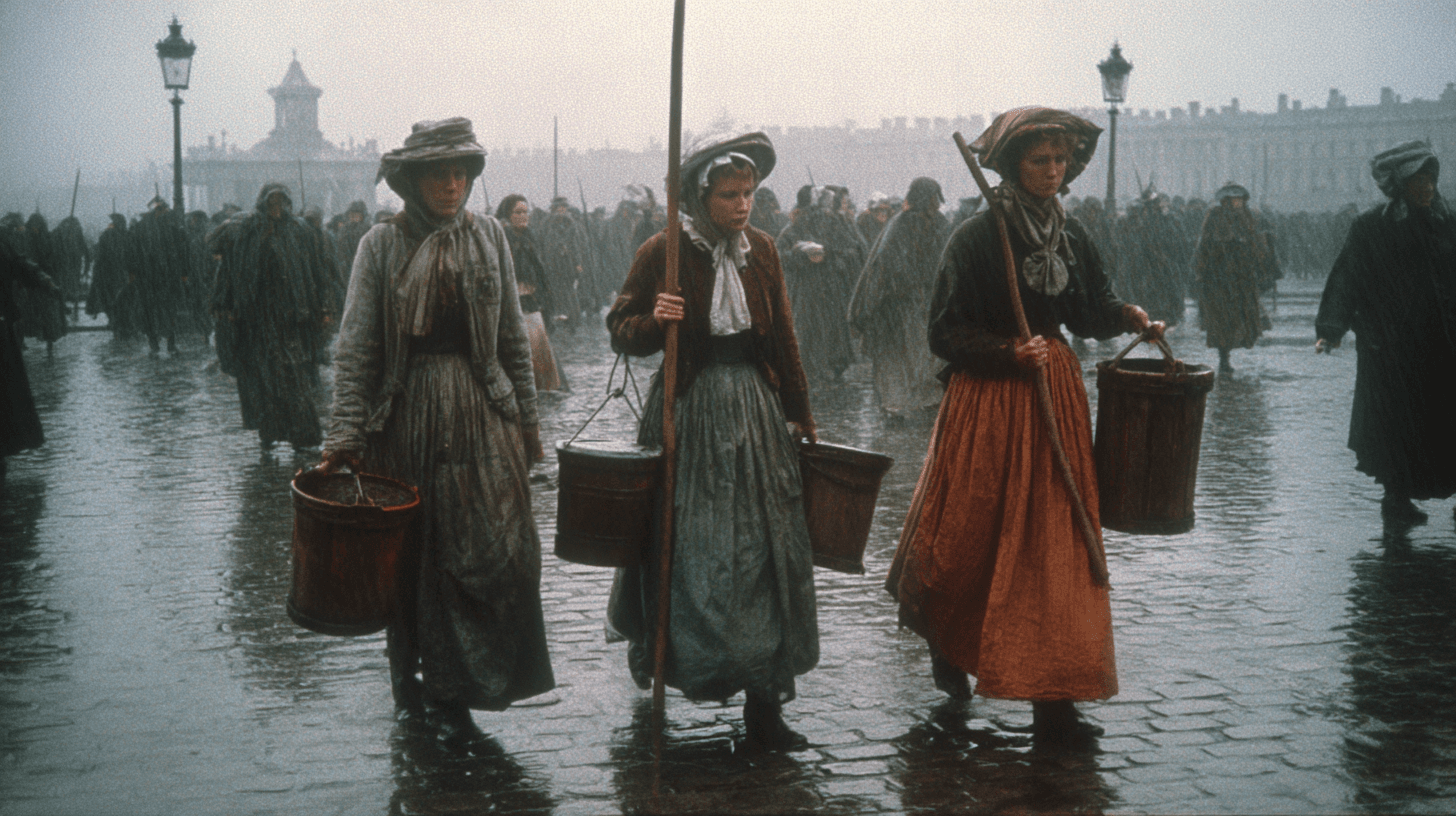
The baker locks his door. Outside, the women are gathering.
It is October 1789, and Paris has been hungry for months. The harvest failed. The price of bread — the one food that matters, the food that is 80% of a poor family's diet — has doubled since spring. A worker who earns 30 sous a day now pays 14 sous for a four-pound loaf that cost 8 sous in July.
The math is not abstract. The math is children who don't eat.
The women of Les Halles, the market district, start marching at dawn. They are fishwives, laundresses, seamstresses — working women who buy bread every day and have watched the price climb beyond reach. They arm themselves with kitchen knives, with sticks, with whatever they can carry. They head for Versailles.
Marie Antoinette never said "Let them eat cake." The phrase was already old when it was pinned to her — Rousseau attributed it to "a great princess" in a book written when Marie Antoinette was nine years old. But the lie captures something true: the distance between those who rule and those who are hungry.
The distance, in October 1789, is twelve miles.
The marchers reach Versailles by evening, soaked from rain, exhausted, furious. They storm the palace grounds. They demand the king come to Paris. They demand bread.
Louis XVI agrees. He is bundled into a carriage. The royal family will never return to Versailles.
The next morning, the crowd escorts the king to Paris. Alongside his carriage, on pikes, are the heads of two royal guards. The women carry loaves of bread. Someone shouts: "We bring back the baker, the baker's wife, and the baker's boy!"
The Revolution has begun. Within four years, Louis and Marie Antoinette will both be dead. The bread price will still be volatile — some things even revolutions cannot fix.
But the lesson is clear: bread is not just food. Bread is social contract. When the contract breaks — when those in power cannot keep bread affordable — the people will come for them.
Rome knew this. "Bread and circuses" wasn't cynicism; it was policy. Egypt knew this — pharaohs stored grain in years of plenty to distribute in years of famine. The Soviets knew this, subsidizing bread prices until the system collapsed.
The Paris bread riots did not end hunger. They ended monarchy.
The women who marched from Les Halles that October morning were not revolutionaries. They were mothers who could not feed their children. The politics came from the arithmetic. When bread costs more than a worker earns, the numbers become radical by themselves.
The baker is still locked inside. The women are still gathering. The math has not changed in two hundred years.
The Facts
- October 5-6, 1789: Women's March on Versailles
- Bread = 80% of poor family's diet
- Price doubled: 8 sous to 14 sous (1789)
- Daily wage: ~30 sous
- Marie Antoinette: never said 'let them eat cake'
- Quote predates her by decades
- March: 7,000-10,000 women
Sources
- Kaplan, S.L. (1976). Bread, Politics and Political Economy
- Hibbert, C. (1980). The Days of the French Revolution
- Rousseau, Confessions (1782) — source of 'cake' quote