The alarm rings at 4 AM. Fatima is already awake.
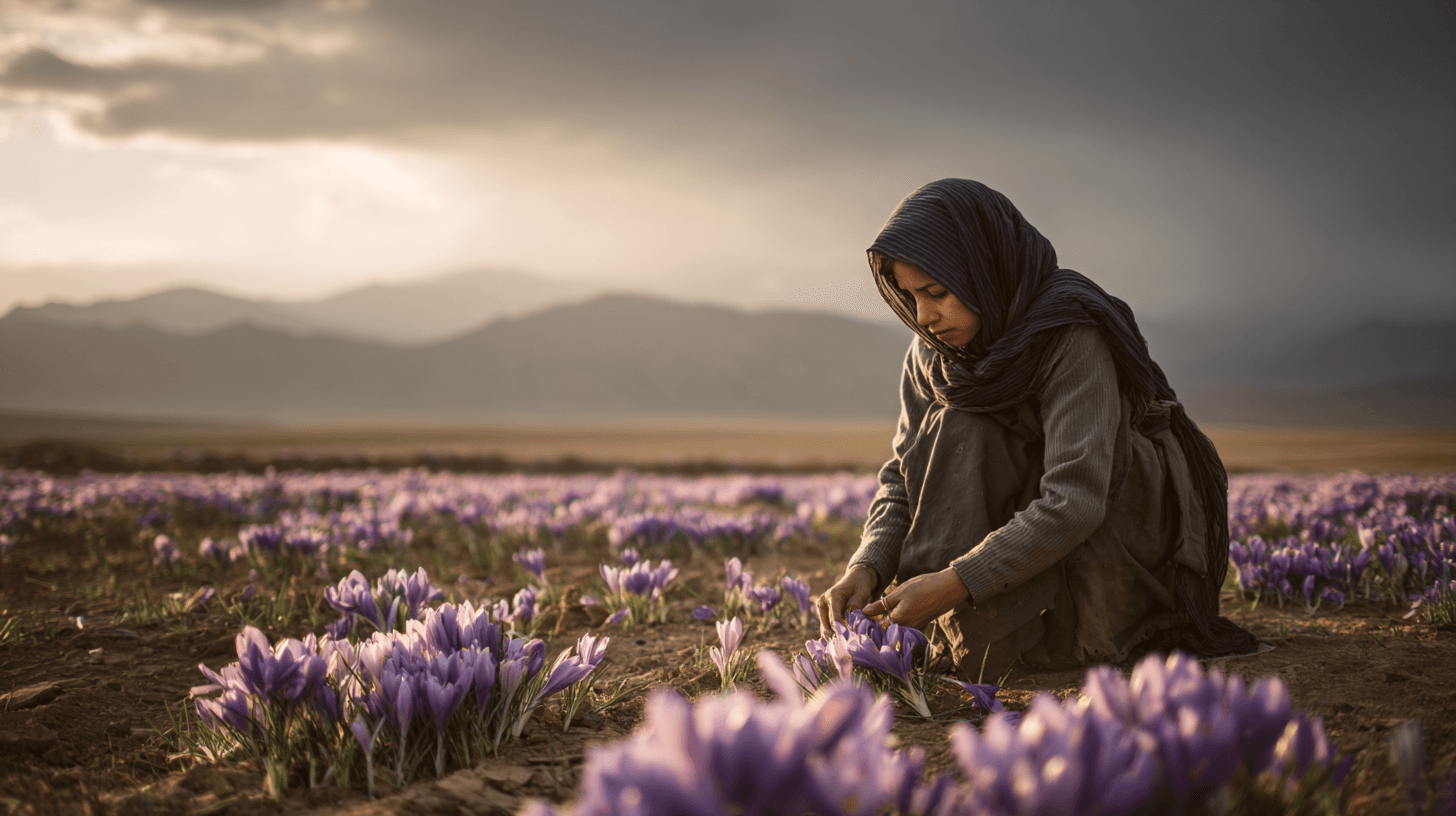
In the fields outside Torbat-e Heydarieh, the crocuses have opened overnight — purple flowers smaller than a child's fist, each one holding three red threads. In twelve hours, the threads will lose their potency. The harvest cannot wait.
Her grandmother worked these fields. Her mother worked these fields. Fatima has worked them since she was six years old, when her fingers were small enough to reach inside the blooms without bruising the petals.
The threads are stigmas — the female part of the flower, evolved to catch pollen. What they catch instead is everything: the dry wind off the plateau, the minerals in the soil, the particular light of Iranian autumn. No one has successfully grown saffron of this quality anywhere else. Scientists have tried. The threads know the difference.
By sunrise, the family is in the fields. Fatima's daughters, her sisters, her cousins — all women. The picking is women's work. The selling is men's work. This has always been true.
Each flower is plucked whole, dropped into a basket, carried back to the farmhouse where the real labor begins. The threads must be separated from the petals by hand — tweezers damage them. Each flower yields three stigmas. Each stigma weighs 0.002 grams. Fatima's family will process 170,000 flowers today. They will produce 340 grams of saffron.
In the Dubai spice souk, that saffron will sell for $3,000.
The family will see perhaps $400.
This is the math of saffron: 150 flowers for a single gram, 440 hours of labor for a single kilogram, three weeks of harvest for a year's income. The threads are worth more than gold by weight, but the hands that pick them earn what hands have always earned in these valleys.
The sun is fully up now. The petals are starting to close. Fatima moves faster, her fingers finding the rhythm that fifty harvests have taught them. By noon, the flowers will be worthless.
By next October, new crocuses will bloom, and she will be here again, in the dark before dawn, racing the sun.
The Facts
- Iran produces 90% of world saffron
- 150-170 flowers = 1 gram
- Harvest window: October-November, 3 weeks
- Price: $3,000-5,000/kg retail
- Family income: ~$400/harvest season
- Stigmas must be processed within hours
- All picking done by hand, traditionally by women
Sources
- Ghorbani, R. (2008). Saffron production in Iran
- Winterhalter & Straubinger (2000). Saffron chemistry
- Field research, Khorasan Province