The caravan master places a bowl between them. White crystals, rough-cut, sparkling in the lamplight. He waits.
His guest — a stranger from the south, seeking passage across the Sahara — hesitates. He knows what comes next. If he takes the salt, he is bound. For forty days, neither can harm the other. Neither can lie. Neither can refuse aid, even at the cost of their own life.
The stranger reaches for the bowl.
This is the salt covenant, and it governed commerce across the ancient world. In Arabic, the root m-l-h gives us both "milh" (salt) and "sulh" (peace treaty). In Hebrew, salt seals sacrifices — "a covenant of salt forever," says the Book of Numbers. The connection is not metaphorical. It is chemical.
Salt preserves. A body without salt dies within days. A contract sealed with salt cannot rot.
The caravans that crossed the Sahara understood this implicitly. You traveled with strangers through territory where there was no law, no police, no court of appeal. Your only protection was the covenant. When a merchant shared salt with you at the start of the journey, he was making himself vulnerable — and making you responsible for his safety.
The forty-day limit was practical. That's roughly how long it takes for the body to fully replace the salt in its system. After forty days, the covenant could be renewed — or not. You were free to become enemies again, if you chose.
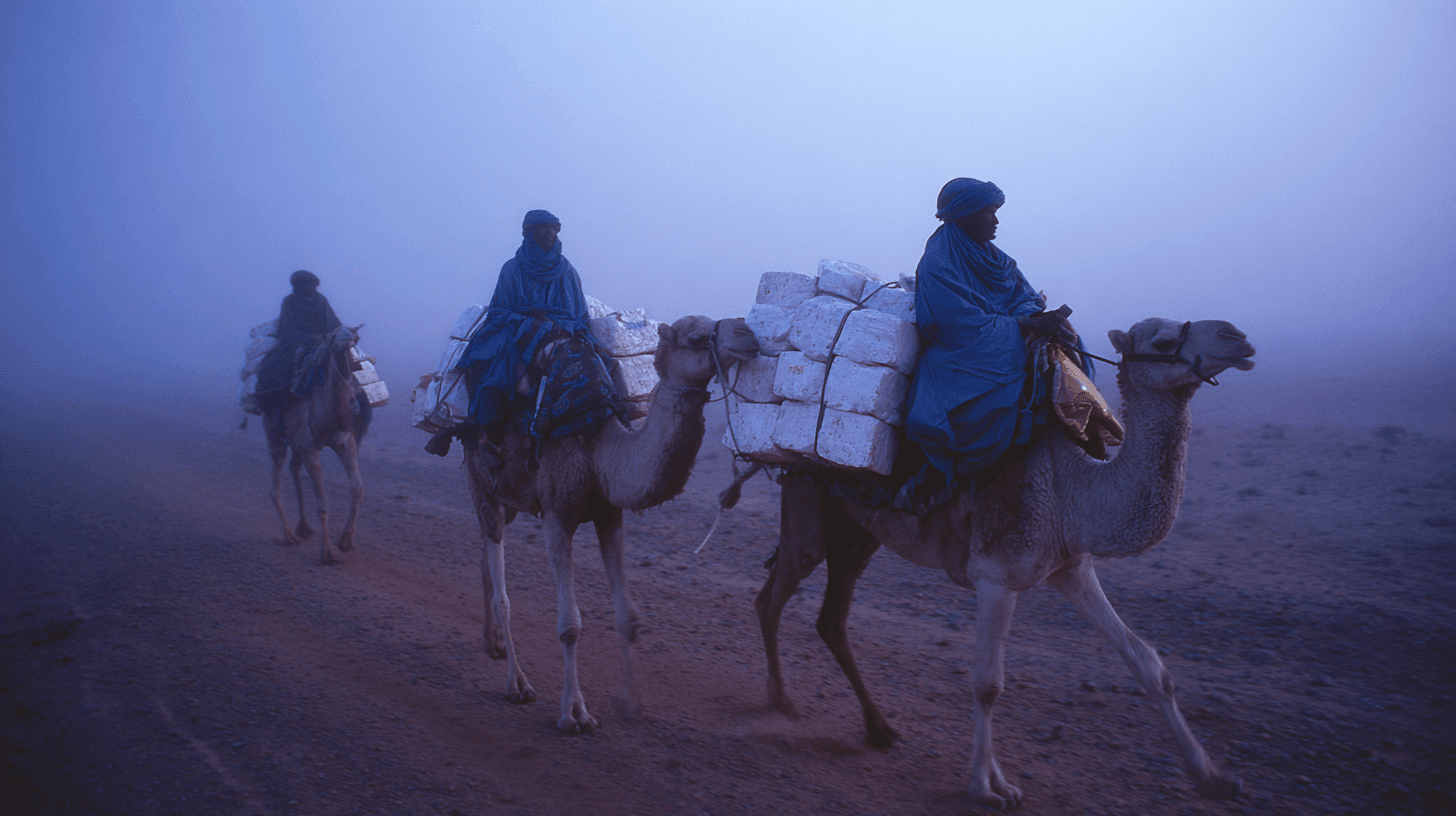
But most chose renewal. The covenant built trust, trust enabled trade, and trade made everyone richer. The salt that sealed the deal was often the same salt being traded — blocks of Saharan mineral salt, cut from ancient lake beds in Mali, worth their weight in gold in the salt-starved forests to the south.
The economics were straightforward: gold flowed north, salt flowed south. What moved in both directions was obligation.
In the tent, the stranger tastes the salt. The caravan master nods. They will travel together for eight hundred miles, through sandstorms and raiders and thirst. At any point, either could kill the other for his goods. Neither will. The salt is in their blood now, binding them more securely than any contract.
This is what we've forgotten: that hospitality was never about kindness. It was about survival. You shared salt because you needed to trust and be trusted. You fed strangers because you would be a stranger tomorrow. The generosity was strategy, hardened into ritual, made sacred through repetition.
The caravan leaves at dawn. Forty days across the empty quarter. The salt covenant holds until they reach Timbuktu.
After that, they're strangers again.
The Facts
- Salt covenant: 40-day mutual protection
- Arabic: milh (salt) and sulh (peace) share root
- Trans-Saharan trade: gold north, salt south
- Taghaza salt mines: blocks worth gold weight
- Body replaces salt every ~40 days
- Covenant appears in Hebrew, Arabic, Berber traditions
- Salt caravans: up to 12,000 camels
Sources
- Bovill, E.W. (1958). The Golden Trade of the Moors
- Numbers 18:19 (Hebrew Bible)
- Levtzion & Hopkins (2000). Corpus of Early Arabic Sources for West African History