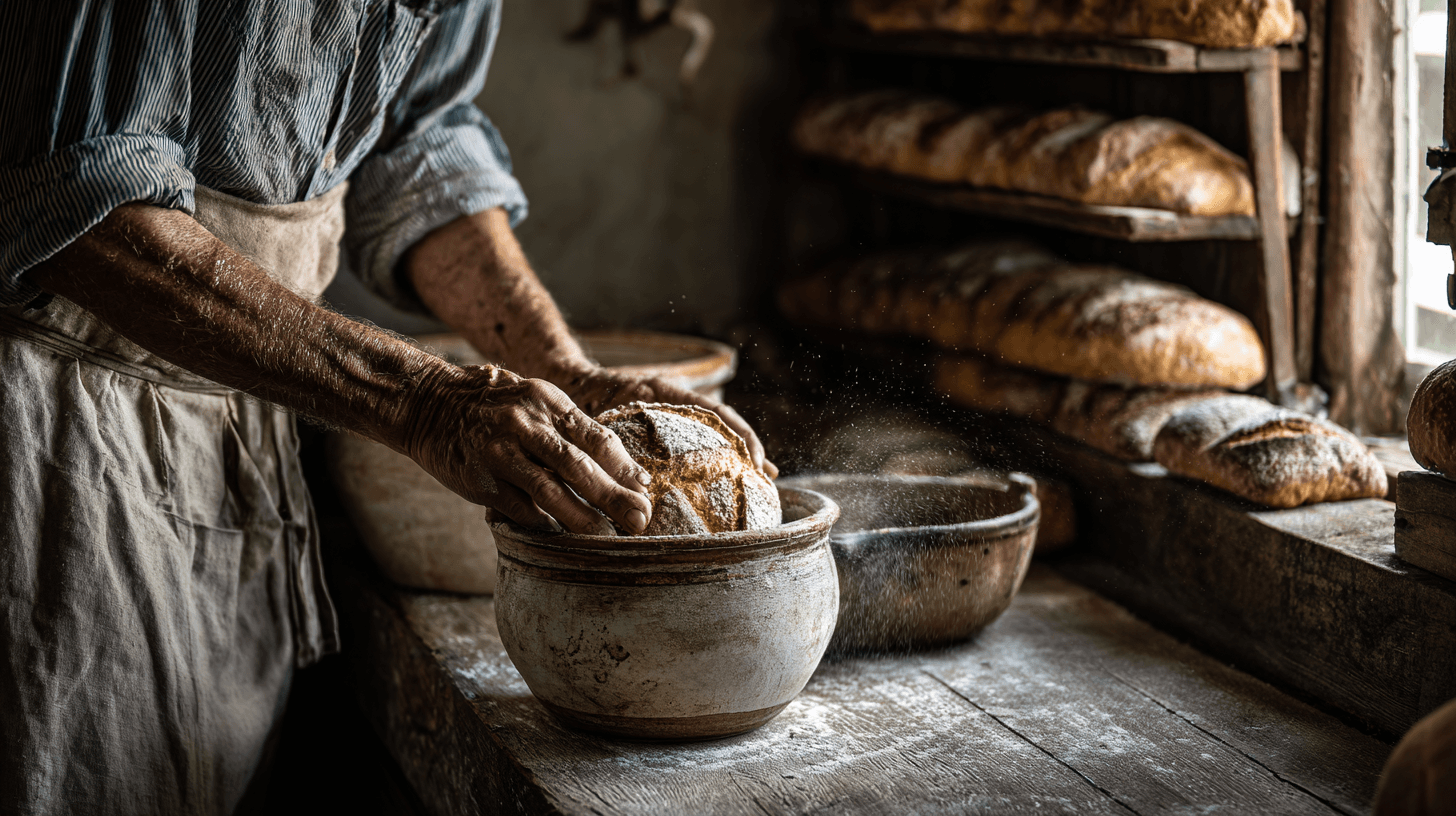
She feeds the mother at 6 AM, as her mother did, as her grandmother did.
The starter sits in a clay crock that has never been washed with soap. Its smell is sharp and alive — yeasts, bacteria, the accumulated chemistry of decades. The bakery rises and falls on this jar of bubbling paste that has no name except "the mother."
Fermentation is not a process. It is a relationship.
Every sourdough, every vinegar, every miso and kimchi and fish sauce depends on a culture — a living community of microorganisms that transforms one thing into another. You can buy yeast in a packet. You cannot buy what generations of feeding have taught a starter to do.
In San Francisco, Boudin Bakery has maintained the same sourdough starter since 1849. They call it "the mother dough." During the 1906 earthquake, while the city burned, a baker's wife rescued the starter before she rescued anything else. The building could be rebuilt. The mother was irreplaceable.
The science is now understood. A sourdough starter contains lactobacillus bacteria and wild yeasts in a ratio specific to its environment — the flour it's fed, the water it drinks, the microbes in the air. Starters develop regional characteristics. San Francisco sourdough tastes different from Paris sourdough because the microbiome is different.
But understanding doesn't mean replicating.
Industrial bakeries have tried to standardize the process. They isolate strains, control conditions, manufacture "authentic" sourdough from lab-grown cultures. The bread is consistent. Something is missing. The depth comes from generations, not formulas.
The same is true of sake, where the toji brewmaster inherits the brewery's yeast cultures along with its name. True of Chinese baijiu, where the fermentation pits have been continuous for centuries. True of fish sauce from Phu Quoc, where the bacterial communities in the wooden vats are protected like family secrets.
Modernization threatens these mothers. Food safety regulations require sterilization. Industrial efficiency demands consistency. The old starters, unpredictable and alive, don't fit the paperwork.
Some survive through protection. Japan's sake yeast cultures are preserved by the Brewing Society, distributed to licensed breweries. Italy's DOP regulations protect regional starters. But much is lost — the village ferments, the family cultures, the mothers that died when the last person who knew how to feed them passed away.
She checks the bubbles. The mother is active, ready to work. She measures out what the dough needs, reserving enough to keep the culture alive for tomorrow, and the day after, and the decade after that.
The bread will rise because something has been rising here for longer than memory. The science explains it. The continuity makes it true.
The Facts
- Boudin starter: continuous since 1849
- Saved from 1906 earthquake by baker's wife
- Sourdough: lactobacillus + wild yeast
- Regional microbiomes = regional flavors
- 'Mother' / 'starter': living culture
- Sake: toji inherits yeast cultures
- Fish sauce: bacterial communities generations old
Sources
- Pollan, M. (2013). Cooked
- Katz, S.E. (2012). The Art of Fermentation
- Boudin Bakery archives, San Francisco